
Da Vinci Library
| Title: | Management Challenges in the 21st Century |
| Categories: | Business Leadership |
| BookID: | 71 |
| Authors: |
Peter F. Drucker |
| ISBN-10(13): | 075065712x |
| Publisher: | Butterworth-Heinemann |
| Publication date: | 2002-03-12 |
| Number of pages: | 205 |
| Language: | English |
| Price: | 74.19 USD |
| Rating: |

|
| Picture: |
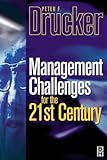
 Buy now
|
| Lent from - until: | 2017-01-10 / 2017-01-10 |
| Description: |
Product Description Drucker sees the period we're living in as one of "PROFOUND TRANSITION--and the changes are more radical perhaps than even those that ushered in the 'Second Industrial Revolution' of the middle of the 19th century, or the structural changes triggered by the Great Depression and the Second World War." In the midst of all this change, he contends, there are five social and political certainties that will shape business strategy in the not-too-distant future: the collapsing birthrate in the developed world; shifts in distribution of disposable income; a redefinition of corporate performance; global competitiveness; and the growing incongruence between economic and political reality. Drucker then looks at requirements for leadership ("One cannot manage change. One can only be ahead of it"), the characteristics of the "new information revolution" (one should focus on the meaning of information, not the technology that collects it), productivity of the knowledge worker (unlike manual workers, knowledge workers must be seen as capital assets, not costs), and finally the responsibilities that knowledge workers must assume in managing themselves and their careers. Drucker's writing career spans eight decades and the years have only served to sharpen his insight and perspective in a way that makes most other management texts seem derivative. While Management Challenges for the 21st Century is no quick airplane read, it is a wise and thought-provoking book that will both challenge and inspire the diligent reader. This book is for people who care about their businesses and careers in the information age--CEOs, managers, and knowledge workers. Highly recommended. --Harry C. Edwards Product Description Management Challenges for the 21st Century looks afresh at the future of management thinking and practice. This astonishing new book from the world's leading management guru revolves around two fundamental issues that are occurring simultaneously: changes in the world economy, and shifts in the practice of management. These developments, especially in developed countries, are crucial in exploring and understanding the challenges of the future. Management Challenges for the 21st Century focuses in on the key questions for all businesses: · What are the new realities? · What new policies are required of companies and executives in order to deal with these changes? Facing a whole swathe of issues head-on in his usual clear-sighted style, Drucker offers up a prescient and informed analysis that will help every executive to build a proactive strategy for the future. *Written by one of the world's leading management gurus *Deals with the pressing challenges facing all organizations in the 21st century *Offers clear-sighted analysis and advice Amazon.com Review No single person has influenced the course of business in the 20th century as much as Peter Drucker. He practically invented management as a discipline in the 1950s, elevating it from an ignored, even despised, profession into a necessary institution that "reflects the basic spirit of the modern age." Now, in Management Challenges for the 21st Century, Drucker looks at the profound social and economic changes occurring today and considers how management--not government or free markets--should orient itself to address these new realities. Drucker sees the period we're living in as one of "PROFOUND TRANSITION--and the changes are more radical perhaps than even those that ushered in the 'Second Industrial Revolution' of the middle of the 19th century, or the structural changes triggered by the Great Depression and the Second World War." In the midst of all this change, he contends, there are five social and political certainties that will shape business strategy in the not-too-distant future: the collapsing birthrate in the developed world; shifts in distribution of disposable income; a redefinition of corporate performance; global competitiveness; and the growing incongruence between economic and political reality. Drucker then looks at requirements for leadership ("One cannot manage change. One can only be ahead of it"), the characteristics of the "new information revolution" (one should focus on the meaning of information, not the technology that collects it), productivity of the knowledge worker (unlike manual workers, knowledge workers must be seen as capital assets, not costs), and finally the responsibilities that knowledge workers must assume in managing themselves and their careers. Drucker's writing career spans eight decades and the years have only served to sharpen his insight and perspective in a way that makes most other management texts seem derivative. While Management Challenges for the 21st Century is no quick airplane read, it is a wise and thought-provoking book that will both challenge and inspire the diligent reader. This book is for people who care about their businesses and careers in the information age--CEOs, managers, and knowledge workers. Highly recommended. --Harry C. Edwards |